-
Expression in portraiture
Over last four months I painted an absurd number of self-portraits. Their number stemmed from my struggle with reducing an entire person to a single expression. It should be straightforward. We all know the formula for your standard snapshot: you look at the camera and paste on a cheesy smile (unless you grew up in…
-
Play and fantasy
[ The first two parts of this essay can be found here and here. Some images and detailed description of this final section have been omitted pending permission from the individual to whom it refers. ] Collection #2 “To my way of thinking, knowing an object does not mean copying it–it means acting upon it.…
-
Confronting and kowtowing to the canon
[ part 2 of the essay which began “To Thine Own Self Be True” ] Collection #1 ”Shades of Santayana! Those who cannot remember the past are condemned to repeat it; ergo, those who can remember the past may overcome it? What does it mean, in a society replete with simulations and reenactments, to overcome…
-
To thine own self be true
[ Then again, consider the source. ] Selfies are easily dismissed as narcissistic or kitschy, but the urge to self-define is neither new nor unimportant. The convention of using physical likeness to express individuality applies along the continuum of portrait images in visual culture: it links lowbrow selfies to high art portraits of Rembrandt. By…
-
Highlighting women as creators (via paper dolls)
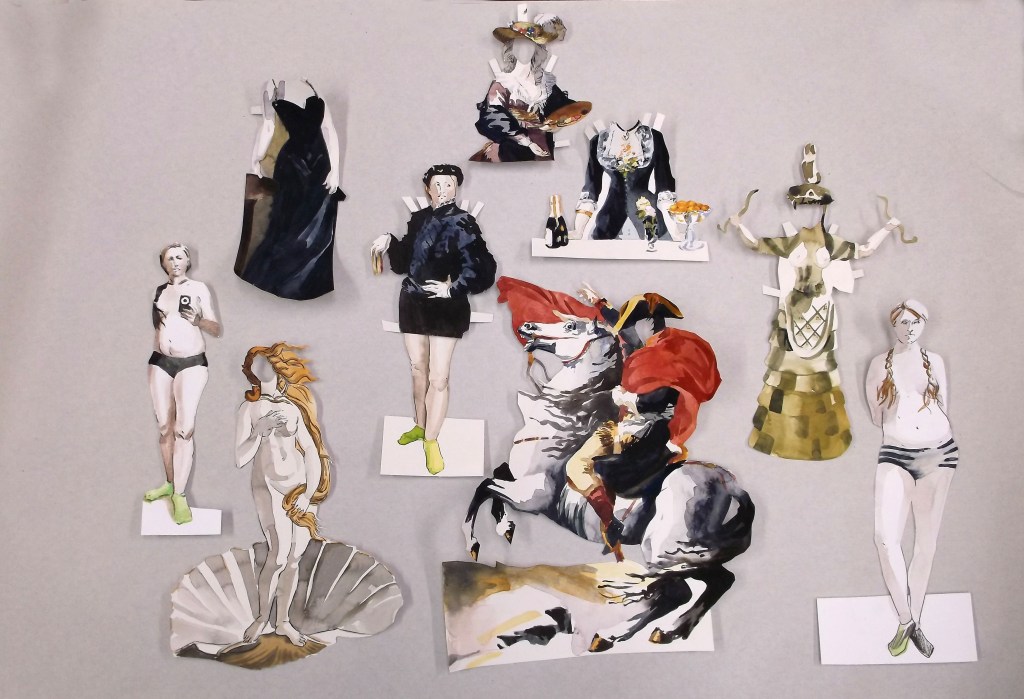
My recent paintings experiment with and assess the personal impact of the artistic canon. In superimposing the art historical canon over my own paper doppelgänger, I engage in a form of portraiture similar to what Svetlana Alpers refers to in The Art of Describing as the “historiating portrait” (14). Such figures “are distinguished by looking…
-
DIY digression: bookmaking
One of the purposes of this blog is to sort through and prioritize intriguing notions and sources. I have an ongoing fascination with investigating how things work. (Hint: that’s a useful lens through which to analyze my art. It tends to be more about figuring out than advocating.) This blog is one approach to that,…
-
DIY digression: letterpress
The Firecracker Press sold me on the sheer excellence of letterpress art. If you’re ever in St. Louis, check them out for good design, poetry readings, edible printed tortillas, and people who know a lot about the history of typography. Most of us can’t afford to reinforce our floors to accommodate ridiculously heavy space hogs. …
-
Perforation
Until today, I only knew one way to perforate paper (without some mysterious steampunk machine). Pounce wheel (Not everyone knows about these things, so I’ll describe them first. I doubt I’d have heard of them if we didn’t sell them at ye olde art supply store. It’s a mural thing.) Pounce pads and powder sound…
-
Museum signs
The Crocker Art Museum signs got me thinking about how a museum’s signage reflects its values. Just to review, a typical sign will look like this one from the Metropolitan Museum of Art: The Met does good, clean signs. They prioritize the artworks themselves while providing substantial additional information. The background color of the sign…
-
Notes from the Crocker
[ 2/25/15 edit: The links to individual artworks no longer function. The Crocker Art Museum’s website no longer serves as a digital representation of their holdings. I hope this is temporary, since it is certainly contrary to the larger trend of art museums releasing their collections digitally. ] It shames me to admit that last…
-
Bi-hourly comic
This, the most complicated mat I’ve cut to date, represents a twenty-four hour period through comics. This was…a stretch for me. (Three of the spaces are blank because nothing particularly noteworthy happened as I slept.) Between 7 and 9 am, I apparently found it crucial to record that: “As it transpired, that cappuchino [sic] at…
-
Proof of concept?
I’m starting something new… My plans owe a grateful nod to work by Jaclyn Seufert and Beth Scher. …oh, and maybe Sandro Botticelli as well.
-
Four months of work
Correspondence art: and a scrap/accordion book to document it 1) Proust’s madeleines 2) Honkers 3) pictures of the pink/purple seal (designed with feedback from mail art #1) 4) bees 5) luggage tags 6) a book to document the project Opiate of the Masses the triptych about seductive things (with a…
-
Souvenirs, part 2
I recently completed what I considered a research trip to Europe. I brought a stack of quality paper and pencils and attempted to create as many souvenirs (aka postcards) as I could while engaged in the inevitable “hurry up and wait” parts of such travel. Obviously Gaudi’s Basilica de la Sagrada Familia made a…
-
Souvenirs
Does anyone else have a problem with the tradition of acquiring and distributing souvenirs? On the surface it is certainly a kind gesture, but… Possibility #1: “You’re going to R—, how lovely! Pick me up a ——- while you’re there!” In this common version, the traveler is transformed from a person with privilege and an…
-
Ambivalence and Paradox, part 4
This post concludes my attempt to answer the question “How can a person technically excluded from the canons of her field and religion relate to them?”, begun in parts 1, 2, and 3. Complexes These hinged blocks relate to a transformation puzzle Naoki Yoshimoto developed in 1971 “as he was searching for a way to…
-
Ambivalence and Paradox, part 3
This post continues to address the question “How can a person technically excluded from the canons of her field and religion relate to them?”, begun in parts 1 and 2. The more things change… An artist I admire gently but firmly informed me that my subsequent attempt to paint a version of a Jan van…
-
Ambivalence and Paradox, part 2
The previous post in this sequence asked: How can a person technically excluded from the canons of her field and religion relate to them? This and subsequent posts will present my attempts to answer this question. Awareness Her first step is to understand the tradition in which she works. With this in mind, last year…
-
Subscribe
Subscribed
Already have a WordPress.com account? Log in now.
 Colleen Wampole