-
Obstructions project
There’s a doozy of a project they like to give us painters over in the Uarts low-residency MFA program. Students divide into groups to give each other challenging assignments. The goals are to practice seeing each others’ work insightfully enough to design assignments which challenge their working habits or preconceptions…just as much as it is…
-
Images and text (learning from book covers and comic books)
Scott McCloud’s Understanding Comics and Making Comics are of course essential reading for fine and sequential artists working with the relationship of text to image. I have spoken at length (with varying degrees of coherence) about the fascinating relationship of comics to fine art (narrative, pacing, spatial concerns, framing, etcetera, ad nauseum, ad infinitum)…but don’t…
-
Revised Limbourg illuminations
Critical Mass (Philadelphia and France) Green Revolution Sierra Nevada
-
Curating is harder than it looks
My longest essay last term was on the subject of polyptychs, their format’s rich addition to meaning, and the concomitant curatorial nightmare they pose. (Sans pompous academic language: they’re cool, but it’s a real pain to show them to best advantage) My essay was righteously indignant about books and public displays which misleadingly or desultorily…
-
Crit with Eileen Neff
Eileen’s comments on Friday reinforced and echoed the group critique two days earlier. (The group crit didn’t include her, so this counts as independent attestation). ideas for combining the art history games with text: I could do altered books, or I could also scan the text and transfer it to a paintable surface. What is…
-
Ye olde reading liste
Spring 2013 [Read in full unless otherwise marked] * = still working on it **=reread select parts or chapters ____________ Alexander, Jonathan. “Labeur and Paresse: Ideological Representations of Medieval Peasant Labor.” The Art Bulletin 72.3 (1990): 436-452. College Art Association. JSTOR. Web. 1 Sept 2013. **Barnett, Lincoln. The Universe and Dr. Einstein. New York: William…
-
Tableau vivant
def. “a silent or motionless group of people arranged to represent a scene or incident” Those who have read Jane Eyre might recall the odd form of charades described midway through. In Charlotte Brönte’s version, participants dressed up and arranged themselves in a static position to provide clues for their audience. As with charades, the…
-
5 in 5 crit notes (warning: loooong)
July 3, 2-6 pm [I’m not sure posting this is a great idea. It might be worthwhile if it helps a classmate flesh out their own crit notes.] general announcements: –go to Vox Populi on Friday (first Friday), look for the Grizzly Grizzly show, look up Hilary Harkness –visit the PaFA museum (reciprocal relationship with…
-
Studio theory
[notes from a discussion/lecture by Astrid Bowlby and Gerard Brown at the University of the Arts on 6.26.13] With what metaphors do we define our studios? How does that affect our art? (Keep in mind that the context for this discussion is a low-residency program in which participants are assigned a space to occupy for…
-
Studio walkthrough
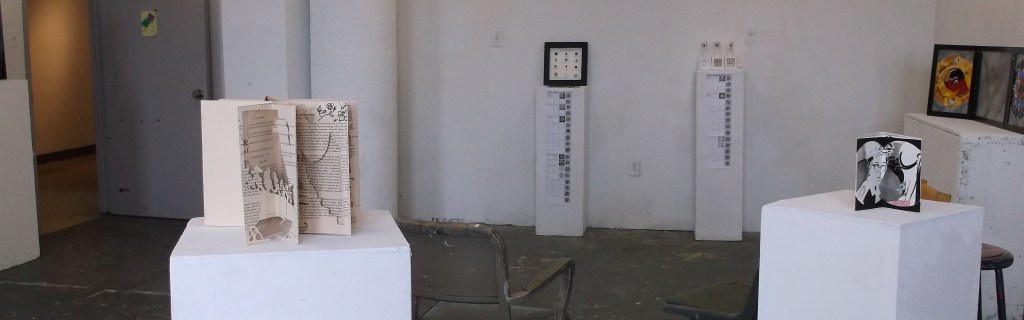
University of the Arts, Philadelphia Spring critique (June 2013) (warning: shaky horribleness)
-
“The Uncanny Valley”
“The Uncanny Valley” …is an essay by Masahiro Mori about robotics. It’s been applied to animation as an explanation for why extremely illusionistic animation styles repel rather than attract. I feel it is a concept which must be understood in order to appreciate the conceptual strength or potential of trompe l’oeil painting.
-
Subscribe
Subscribed
Already have a WordPress.com account? Log in now.
 Colleen Wampole